Monday, August 26, 2024

ARC Review: The Saint of Heartbreak, by Morgan Dante

After his betrayal with a kiss, Judas Iscariot dies in despair and goes to Hell. When Christ saves other souls during the Harrowing of Hell, he leaves Judas behind—but not alone in the ninth circle, where the most detestable traitors go. Callous, resigned, and abandoned by God long ago, the Devil sees Judas as a pathetic wretch, but he soon finds a kindred spirit. As the centuries pass, they struggle to find even a sliver of happiness in Hell. Doomed by the narrative, will they find happiness, or will their story continue to be a tragedy?

My thanks to the author for providing an ARC copy.

Morgan Dante's The Saint of Heartbreak is a story some might find blasphemous, but at its core, it's a story about finding companionship in the direst circumstances, and finding forgiveness within oneself. The first chapters, depicting events from the New Testament, set quickly the scene, introducing the reader to Judas through the eyes of Yeshua; the rest of the book is from Lucifer's POV, and it does get the reader to sympathise with the Devil. Morgan Dante's Hell is not Dante's Inferno, but a gentler place than one might expect - while being very clearly a place of eternal torment.

The relationship between Judas and Lucifer grows organically, from a tentative fascination to a kind of friendship; transactional sex becomes tender as all veils fall and their souls are laid bare. The choise to never have Judas' POV is interesting, because we only see him through someone else's eyes: he's tormented by what he's done, by his betrayal, by the loss of Yeshua, and he often seeks way to punish himself, but slowly finds a way to forgive himself. And Lucifer, in turn, grows to make peace with his past.

This book wouldn't work without the presence of Lucifer's fantastic supporting cast. Hell isn't explored thoroughly, but rather painted with a few vignettes, exploring other circles, other damned, and the Dukes of Hell. Lilith in particular makes for an incredible secondary character. Even a few Angels make an appearance, and the little snippets of the Fall are harrowing, showing the casual cruelty of the so-called good side.

Dante's writing is, as usual, exquisite. There's a few odd turns of phrase, but generally speaking, the vibes are always immaculate with this author.

The Saint of Hearbreak is an unexpected treasure.

✨ 4 stars

Monday, August 19, 2024

Review: The Weavers of Alamaxa, by Hadeer Elsbai

The Daughters of Izdihar—a group of women fighting for the vote and against the patriarchal rule of Parliament—have finally made strides in having their voices heard...only to find them drowned out by the cannons of the fundamentalist Ziranis. As long as Alamaxa continues to allow for the elemental magic of the weavers—and insist on allowing an academy to teach such things—the Zirani will stop at nothing to end what they perceive is a threat to not only their way of life, but the entire world.
Two such weavers, Nehal and Giorgina, had come together despite their differences to grow both their political and weaving power. But after the attack, Nehal wakes up in a Zirani prison, and Giorgina is on the run in her besieged city. If they can reunite again, they can rally Alamaxa to fight off the encroaching Zirani threat. Yet with so much in their way—including a contingent of Zirani insurgents with their own ideas about rebellion—this will be no easy task. And the last time a weaver fought back, the whole world was shattered.

"Safe in the knowledge that she was powerful."

Hadeer Helsbai's The Weavers of Alamaxa is the hectic conclusion to the duology started with The Daughters of Izdihar. The novel picks up where the first book ended, and from there doesn't stop a moment, careening towards an ending that ties up all the loose threads but feels unearned because we didn't have time to really delve into the changing situations. Events take place at a fast pace, and the new characters and setting suffer from it. The first conflict of the novel gets resolved in the blink of an eye, in order to put all pieces on the board and proceed with a war that becomes too rushed as well.

A trilogy would have allowed this series to breathe; we could have spent the whole of the second novel at the Zirani court and in Zirani, to learn more about their people and have time to get interested in those characters. Instead, the rushed resolution means we care little for them when disaster strikes. The core characters from the first volume are of course exempt from this, and a tragic event is treated with the grace and attention it deserves. But the focus on the war means that all the things that made the first book so memorable - the political struggle and the battle for bodily and political authonomy - take the backseat.

The two POVs' journey, on the other hand, is well-executed: Nehal softens her edges as she learns the struggles of the poor, and she has a few memorable scenes; Giorgina undegoes a metamorphosis, going from a meek character to one who fights for what's right. Malak of course continues to stun with her political acumen and her strength, the remaining Daughters of Izdihar make their appearance, and Nico handles himself well; the Zirani monarchs, while underdeveloped, make for interesting villains. The worldbuilding suffers from the fast pace, but new information about the world gives a new perspective.

The Weavers of Alamaxa is a book that could have been more.

✨ 3.5 stars

Monday, August 12, 2024

Snippet: Empire of the Feast, by Bendi Barrett

We awaken with Riverson, 32nd ruler of the Stag Empire, as he attempts to govern without the memories of his previous lives. To survive the ever-sharpening gears of war, he will need to mend the political schisms threatening to tear his empire apart while maintaining the erotic rituals holding off the eldritch horror known only as the Rapacious.

“We will eat the stars and drench the darkness in ecstasy.”

Bendi Berrett's Empire of the Feast is a sci-fi novella with a touch of magic, compact and luxurious. In less than a hundred pages, the author paints the delicate balance of an intergalactic empire held together against an eldritch foe only thanks to the power surges created by a never-ending orgy. Despite the particular subject, the book isn't too explicit, and follows the efforts of the newly resurrected Emperor attempting to regain his footing and stop a coup, having been brought back memoryless and with a different gender. This delightfully queer page-turner of a novella packs a complex journey that resolves in less than a day; it only stumbles in the Epilogue, where it tries to tie too neat a bow to the detriment of a perfect roller-coaster.

✨ 4 stars

Monday, August 5, 2024

Review: So Let Them Burn, by Kamilah Cole

Faron Vincent can channel the power of the gods. Five years ago, she used her divine magic to liberate her island from its enemies, the dragon-riding Langley Empire. But now, at seventeen, Faron is all powered up with no wars to fight. She’s a legend to her people and a nuisance to her neighbors. When she’s forced to attend an international peace summit, Faron expects that she will perform tricks like a trained pet and then go home. She doesn’t expect her older sister, Elara, forming an unprecedented bond with an enemy dragon—or the gods claiming the only way to break that bond is to kill her sister.
As Faron’s desperation to find another solution takes her down a dark path, and Elara discovers the shocking secrets at the heart of the Langley Empire, both must make difficult choices that will shape each other’s lives, as well as the fate of their world.

"She'd been a liar longer than she'd been a saint."

Kamilah Cole's So Let Them Burn is a YA fantasy with dragons, set in a queenormative world. The two POVs follow two sisters, five years after a war against a colonizing empire wherein the younger sister was chosen by the gods of their small nation to protect themselves against the invasion. The choice to sidestep the big war and begin with five years later, as reconstruction is well under way and the young nation opens up peace talks, is a strong one, that translates into the author having to infodump frequently, but it's done deftly enough and the exposition isn't too clunky.

The crown jewel of the book is certainly the relationship between the two sisters. Their love for each other is what motivates them and pulls the plot in certain directions; it's what sets things in motion. Twists and turns abound as the two of them are separated and drawn to harsh choices that might change the world, but the execution isn't strong and the choices, the twists, the revelations, feel unearned. We don't have time to get attached, to feel the sense of betrayal and the outrage, because the characters go from one situation to the other without letting the tale settle properly. The dragon school isn't explored, save from off-hand remarks and off-screen development that means one thing that was plainly meant to be an emotional beat towards the end falls flat.

The romantic relationships feel unearned, too, at least Faron's sudden attachment to a boy she's mistrusted for most of the book. Elara's slow burn with an enemy is handled better, with the two girls growing closer as circumstances force proximity and an alliance forming out of necessity.

The magic system was intriguing, as were the glimpses of the supernatural and the way they were linked to Jewish folklore; we have demons and angels and the name of God. There are horror elements, in a sense, but the deepest horror is human depravity. The worldbuilding is interesting, with gods and dragons and a magic system that allows one to call upon the spirits of ancestors, and a darker magic being explored. The revelations about the past make for an intriguing lore, and the abrupt ending keeps the reader on their toes.

So Let Them Burn is a sweet YA debut, perfect for young readers.

✨ 3.5 stars

Monday, July 29, 2024

Review: The Sins on Their Bones, by Laura R. Samotin

Dimitri Alexeyev used to be the Tzar of Novo-Svitsevo. Now, he is merely a broken man, languishing in exile after losing a devastating civil war instigated by his estranged husband, Alexey Balakin. In hiding with what remains of his court, Dimitri and his spymaster, Vasily Sokolov, engineer a dangerous ruse. Vasily will sneak into Alexey’s court under a false identity to gather information, paving the way for the usurper’s downfall, while Dimitri finds a way to kill him for good.
But stopping Alexey is not so easy as plotting to kill an ordinary man. Through a perversion of the Ludayzim religion that he terms the Holy Science, Alexey has died and resurrected himself in an immortal, indestructible body—and now claims he is guided by the voice of God Himself. Able to summon forth creatures from the realm of demons, he seeks to build an army, turning Novo-Svitsevo into the greatest empire that history has ever seen. Dimitri is determined not to let Alexey corrupt his country, but saving Novo-Svitsevo and its people will mean forfeiting the soul of the husband he can’t bring himself to forsake—or the spymaster he’s come to love.

"If I die first, I'll tell you the secrets of heaven."

Laura R. Samotin's The Sins on Their Bones is an extraordinary tale of healing from trauma and finding your inner strength again after enduring an abusive relationship, a well-written dark fantasy story with Jewish accents and folklore and a Russian-inspired court, a tale of the supernatural that doesn't shy away from its horrors, even when it's creatures of good that are doing the violations. It's a quiet story, following the three POVs of the grief-stricken former Tzar, his loyal spymaster, and the man who abused the Tzar's heart, body, and empire.

The abuser's POV is truly unsettling; he's so enamored of his narrative, so disgustingly lacking in self-awareness, that it proves to be a challenging read. He's a perfect villain, not moustache-twirling but one who believes he's the hero of his own story when in truth, we see the depths of his depravity in stark vividness. The book is prefaced by trigger warnings, and one would do best to take heed of them; the upsetting material isn't just in his chapters, but is reminisced and witnessed in the other POVs as well. The spymaster, too, has a painful past, that he'll try to overcome while he helps the former tzar do the same. The tzar's POV is heartbreaking, for his love for his abuser, even though he's aware of the things he did, is still ever-present and drenched in agony, and he can't bring himself to find comfort as his kingdom is taken apart by a madman.

The supporting cast truly shines. Dimitri has friends, his inner court, well-rounded characters with inner lives, who love him and try to bring him back from the abyss (they enrich the queerness of the book, as one of them is nonbinary and another is aroace). The story starts after the war that broke the realm, and pieces of information are given here and there, to slowly paint the picture of what happened. Not everything is clear - how exactly Alexey turned to the Holy Science, for instance - but the atmosphere makes up for it. Another truly tragic character is Dimitri's half-brother, who bears the brunt of Alexey's twisted affections in the absence of the brother whom he resembles so much; his story was heartbreaking.

The magic system was intriguing, as were the glimpses of the supernatural and the way they were linked to Jewish folklore; we have demons and angels and the name of God. There are horror elements, in a sense, but the deepest horror is human depravity.

The book, despite no indication of this, seems to be part of a series given the epilogue, but I was expecting a standalone.

The Sins on Their Bones is a powerful tale.

✨ 4 stars

Monday, July 22, 2024

Review: A Sweet Sting of Salt, by Rose Sutherland

When a sharp cry wakes Jean in the middle of the night during a terrible tempest, she’s convinced it must have been a dream. But when the cry comes again, Jean ventures outside and is shocked by what she discovers—a young woman in labor, already drenched to the bone in the freezing cold and barely able to speak a word of English. Although Jean is the only midwife in the village and for miles around, she’s at a loss as to who this woman is or where she’s from; Jean can only assume she must be the new wife of the neighbor up the road, Tobias. And when Tobias does indeed arrive at her cabin in search of his wife, Muirin, Jean’s questions continue to grow. Why has he kept his wife’s pregnancy a secret? And why does Muirin’s open demeanor change completely the moment she’s in his presence?
Though Jean learned long ago that she should stay out of other people’s business, her growing concern—and growing feelings—for Muirin mean she can’t simply set her worries aside. But when the answers she finds are more harrowing than she ever could have imagined, she fears she may have endangered herself, Muirin, and the baby. Will she be able to put things right and save the woman she loves before it’s too late, or will someone have to pay for Jean’s actions with their life?

"She held her love in an open hand."

Rose Sutherland's A Sweet Sting of Salt is a sapphic retelling of the tale of the selkie wife, set in Nova Scotia during the Nineteenth Century. The author weaves an atmospheric story of longing and loneliness, depicting period-typical homophobia and a deft exploration of the wrongness of forced marriage. The growing tenderness between Jean and Muirin is written beautifully, and as the stakes get higher and the husband turns into a menacing antagonist the story almost turns into a horrific tale, with palpable tension woven in the narration.

The cast was fantastic. Jean, the protagonist and only POV, a midwife with a secret in her past that led her to being ostracised for a long while, stuns with her bravery and her kindness. Muirin is a perfect match, a loving mother and a brave character whose playfulness shines through sometimes, with a secret of her own. The crown jewels of the book are certainly their interactions, and especially the moments when Jean teaches English to Muirin. Jean's mentor and her friend, a mother and son, take a bigger role than expected; Jean's relationship with her mentor is beautifully explored, especially in one touching moment, but it's the small moments with the other townsfolk, as we see Jean carve a new life for herself, that really stir the heart. Muirin's husband is an excellent antagonist, a stalking threat who believes that possession is love.

The mystery is built up slowly, with little clues here and there, but it's easy to clock in on the truth even if one picked up the book only thinking it a work of historical fiction. Jean is perhaps a little slower to catch on, but when she does, it's with a heart full of love. The full scope of the revelations however is a surprise even to a more savvy reader.

A Sweet Sting of Salt is a stunning debut.

✨ 4 stars

Monday, July 15, 2024

Review: The Bedlam Stacks, by Natasha Pulley

In 1859, ex–East India Company smuggler Merrick Tremayne is trapped at home in Cornwall with an injury that almost cost him his leg. When the India Office recruits him for an expedition to fetch quinine--essential for the treatment of malaria--from deep within Peru, he knows it's a terrible idea; nearly every able-bodied expeditionary who's made the attempt has died, and he can barely walk. But Merrick is eager to escape the strange events plaguing his family's crumbling estate, so he sets off, against his better judgment, for the edge of the Amazon.
There he meets Raphael, a priest around whom the villagers spin unsettling stories of impossible disappearances, cursed woods, and living stone. Merrick must separate truth from fairy tale, and gradually he realizes that Raphael is the key to a legacy left by generations of Tremayne explorers before him, one which will prove more valuable than quinine, and far more dangerous.

"He wasn't crude work but the ruin of something fine."

Natasha Pulley's The Bedlam Stacks is an atmospheric story set in Chile and filled with magical realism, full of wonder. We follow Merrick, a disabled character, as he has to join an expedition he would have rather abandoned because of his new disability. In the liminal space of a town his grandfather used to visit once, he will find Raphael, a mysterious man who seems to be ailed by a strange condition.

The prose as always with Pulley, was spectacular, so very simple and yet complex and magical. It's a slow reveal of a novel, a quiet treasure that one should savor. The magical elements come together slowly, revealing the magic behind the ordinary and beyond the objective European mind, unveiling a wholly different way of thinking.

I appreciated how Merrick was written, exploring his disability and his struggles in a very believable way, and I loved what we got to see of Raphael. Their feelings are never made explicit, but this is undoubtedly a love story, one that has a bittersweet ending. Like other Pulley characters, they are flawed and sometimes nasty, but always so very human. And fans of the Watchmaker of Filigree Street will find an incredible cameo and appreciate even more a beloved character.

The magical realism aspects were very intriguing, especially once the veil is lifted and things are revealed to be much more than they seem at first glance. The other characters feel a bit empty, with only the physician having a little depth.

The Bedlam Stacks is a quiet marvel.

✨ 4 stars

Monday, July 8, 2024

Review: Unholy with Eyes like Wolves, by Morgan Dante

Noémie, a dishonored and widowed noblewoman in early 17th century Hungary, finds herself in an unenviable position: after grievous trauma and loss, her last chance to regain her honor comes when she must serve as Lady Erzsébet Báthory’s handmaiden. Báthory is stoic and imperious, and as Noémie struggles to acclimate and accept her present and future, she begins to have dreams about a mysterious woman. Worse, there are stories of disappearance and deaths in the castle, and Noémie might be next.

"Sometimes, we need monsters to protect us."

Morgan Dante's Unholy with Eyes like Wolves is a gory sapphic exploration of the horrors of life as a woman, set in Hungary and drawing on the myth of Erzsébet Báthory and the story of Carmilla, throwing in the mix a sympathetic protagonist that isn't afraid to get her hands dirty. Noémie holds her own as a character in her own right, surrounded by the figures of legends, and her journey is both touching and invigorating.

The book delves deep into themes of grief, mortality, morality, and self-actualization, weaving a tragedy steeped in languid eroticism that climaxes in sex scenes that are gory and bloody and deeply sensual. The prose is excellent, a slow and rich journey, but it's plagued by a number of typos that destroy the magic a little.

The 17th-century Hungary setting is clearly researched, even with phrases sprinkled throughout the text, and the exploration of the politics of the time is certainly intriguing.

The almost-female cast is the real gem of this book, with the relationships that are woven not only between the three women at the center, but also with the serving women at the castle and with others, and especially the strong bonds of sisterhood explored when the three wise women help Noémie with an abortion. The book, as one might imagine, tackles triggering topics, but does it expertly.

Unholy with Eyes like Wolves is a decadent delight.

✨ 4.5 stars

Monday, July 1, 2024

Monday, June 24, 2024

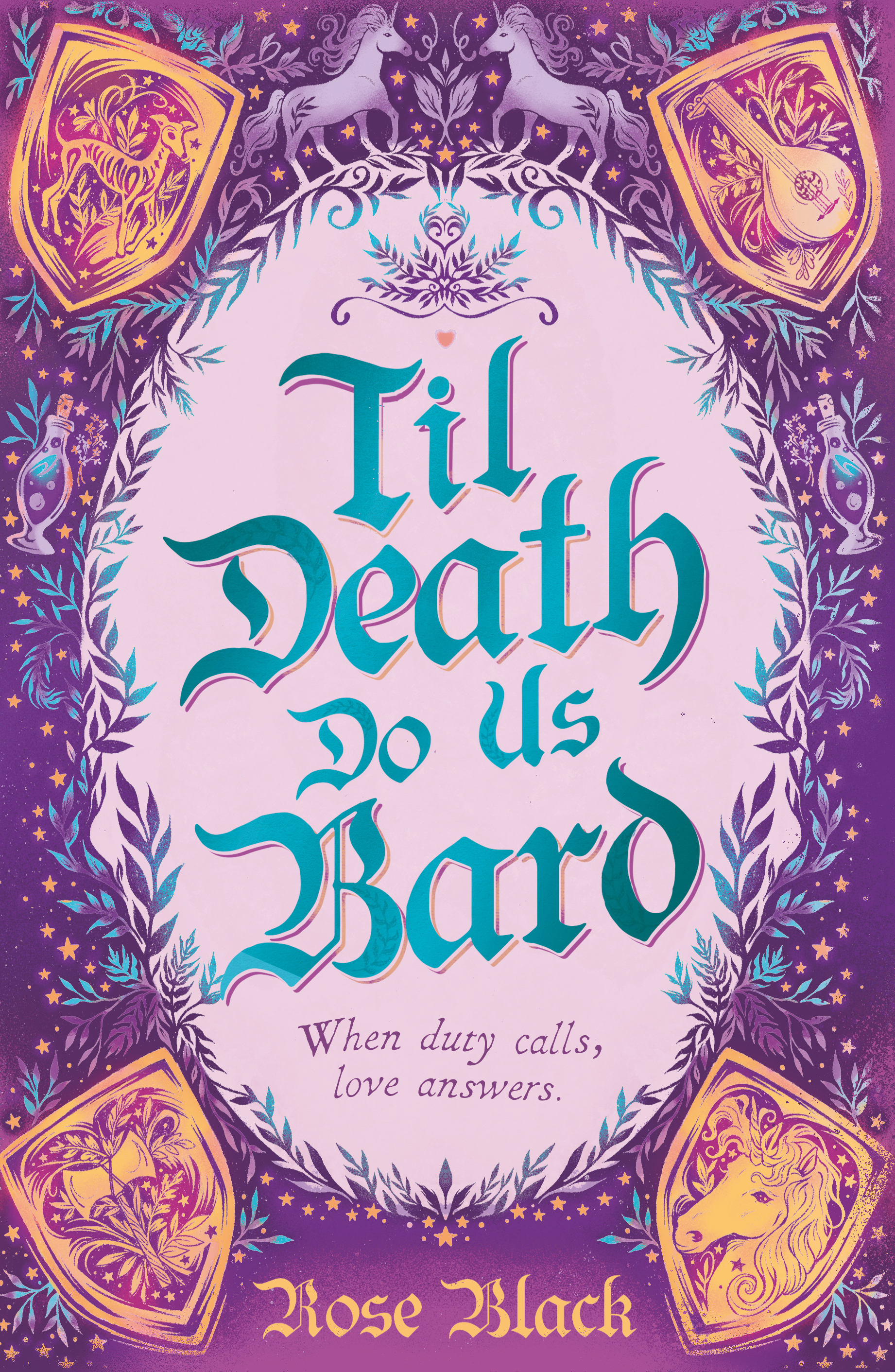
Review: Til Death Do Us Bard, by Rose Black

It's been almost a year since Logan 'The Bear' Theaker hung up his axe and settled down with his sunshiny bard husband, Pie. But when Pie disappears, Logan is forced back into a world he thought he'd left behind. Logan quickly discovers that Pie has been blackmailed into stealing a powerful artifact capable of creating an undead army. With the help of an old adversary and a ghost from his past, Logan sets out to rescue his husband.
But the further the quest takes him, the more secrets Logan uncovers. He'll need all his strength to rescue his husband - but can he save their marriage?

"Everything's a story."

Rose Black's Til Death Do Us Bard is an adventure that attempts to be cozy and funny, but the humor falls flat and the coziness disappears very quickly. The main characters' relationship, which is established by the time the book starts, is recounted from its inceptions in vignettes in-between chapters, painting a sweet story of grabbing second chances and finding love in one's forties.

The main plot reveals secrets and lies that should color at least a bit of the relationship, but the conflict solves pretty quickly as the two husbands focus on saving the realm from a threat. The world was generic, painted quickly, which is a shame, because there were interesting things about necromancy and unicorns, and an intriguing backstory about the world was introduced towards the end, which didn't give enough time to really appreciate the sudden dramatic paradigm shift.

The supporting cast was strong, with a ghost ex-wife, a sheltered shepherd, and an old necromancer countess whose sexual harassment of all the male characters was unfortunately used as a source of humor.

The ending ties up all loose threads, and it's certainly creative.

Til Death Do Us Bard is a book that had great potential.

✨ 3.5 stars